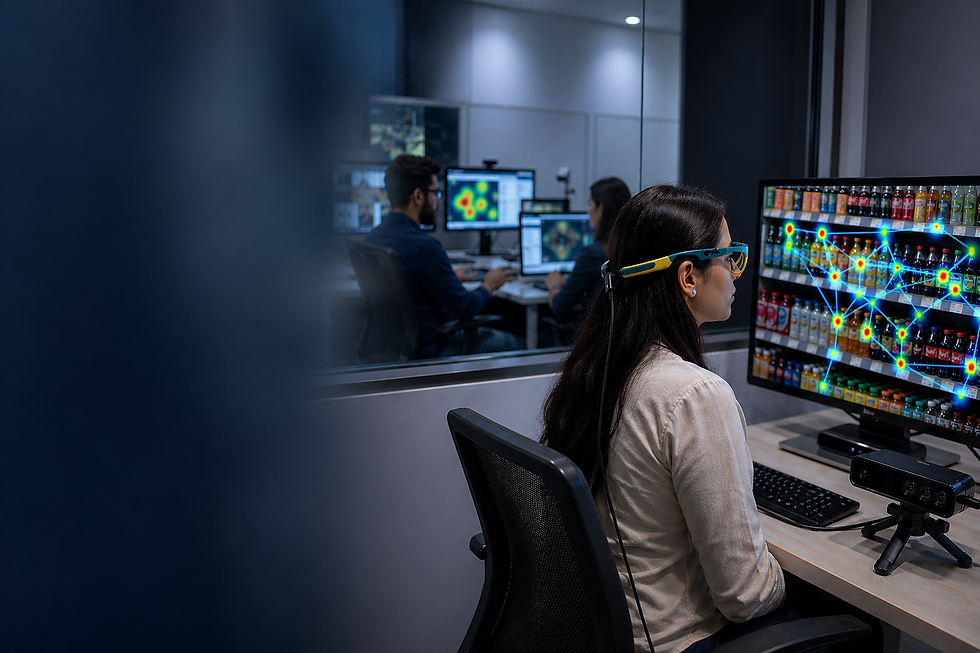
Behavioural evidence, not opinions.
See what people notice.
Understand what drives decisions.
First Fixation
Initial Attention
The first point the eyes focus on upon viewing a scene.
Early Visual Pull
Immediate Engagement
What quickly draws the eyes and holds initial attention.
Never Seen
Ignored Elements
Parts of the scene that are present but never noticed.
Scanning Patterns
Attention Movement
The paths and sequences the eyes follow while exploring.
Processing Break
Overload or Confusion
Moments where visual processing falters or stops.
What eye-tracking captures.
Unconscious behaviour that shapes choice, comprehension, and effort.
01
First Attention
02
Visual Sequence & Flow
03
Fixation & Dwell
04
Missed Elements
05
Cognitive Load Indicators
What we measure.
Why it matters.
More information doesn’t mean more clarity
Attention decides before logic does
What’s visible isn’t always noticed
01
Retail & Shopper Environments
Understanding shelf navigation, visual clutter, decision shortcuts, and in-store attention patterns.
02
Packaging & On-Pack Communication
Identifying which pack elements are noticed, ignored, misunderstood, or compete for attention.
03
Advertising & Communication
Measuring early attention, message cut-through, visual hierarchy, and brand visibility.
04
UX, Interfaces & Digital Journeys
Mapping navigation behaviour, confusion points, attention drop-offs, and task completion.
05
A/B & Comparative Testing
Evidence-based comparison of design alternatives to identify what truly performs better.
Where eye-tracking is applied.
01
Retail & Shopper Environments
Understanding shelf navigation, visual clutter, decision shortcuts, and in-store attention patterns.
02
Packaging & On-Pack Communication
Identifying which pack elements are noticed, ignored, misunderstood, or compete for attention.
03
Advertising & Communication
Measuring early attention, message cut-through, visual hierarchy, and brand visibility.
04
UX, Interfaces & Digital Journeys
Mapping navigation behaviour, confusion points, attention drop-offs, and task completion.
05
A/B & Comparative Testing
Evidence-based comparison of design alternatives to identify what truly performs better.
